
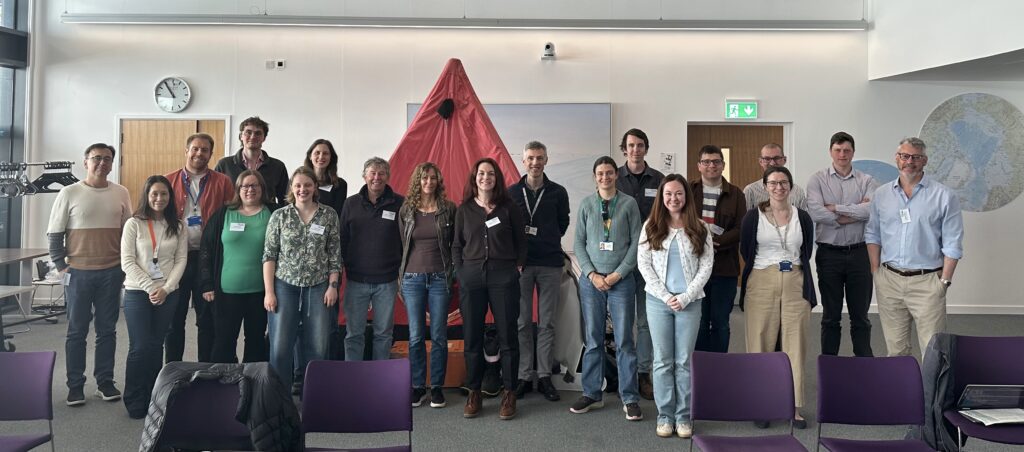
The DEFIANT General Assembly took place at the British Antarctic Survey in Cambridge, from the 12th – 14th May 2026.
DEFIANT began in 2021, with the aim of understanding the changes that had occurred in Antarctic sea ice and whether they might continue or re-occur. Five years on, and after the extreme low sea ice period of 2023-present, we gathered for a final full project meeting to address what we’d learnt and the outstanding questions.
Several presentations shared advances in our understanding that have been made through international collaborations using relatively new oceanographic datasets that span the past 10 years and thus the period of dramatic Antarctic sea ice change. We heard about very recent observational campaigns through DEFIANT, notably the use of Autosub long-range under ice in the Weddell sea in 2026, and discussed how this data would be analysed to give new insights in the coming months. A second key rung of DEFIANT has been advances in our understanding of how satellite measurements which are used to derive snow and sea ice thickness, critical for understanding changes in the sea ice, are really ‘seeing’ the ice. We also discussed the consequences of Antarctic sea ice loss for ocean-ice-biogeochemistry. Finally, we shared modelling advances made in DEFIANT whereby changes to details of the ocean and sea ice model components can have large impacts on the sea ice distribution, which is critical for accurate modelling and projections of the system.
In a wrap-up discussion, we addressed the challenges of combining specialisms (for example, satellite observations, in situ observations, traditional modelling, and machine learning techniques) and the physical domains of ocean, atmosphere and sea ice. We considered gaps in our ability to observe the ocean and the sea ice, especially its volume and properties other than extent, at the frequency and spatial scale needed (either from satellite or in situ); the ability of climate models to simulate sea ice; and outstanding science questions. Our understanding of the role of sea ice in moving freshwater spatially in the ocean, which is critical for global ocean circulation, and how well we are able to both observe and model this, was a recurring theme. We also discussed how the recent extreme sea ice conditions might be viewed in a longer-term climate context.
Written by Caroline Holmes